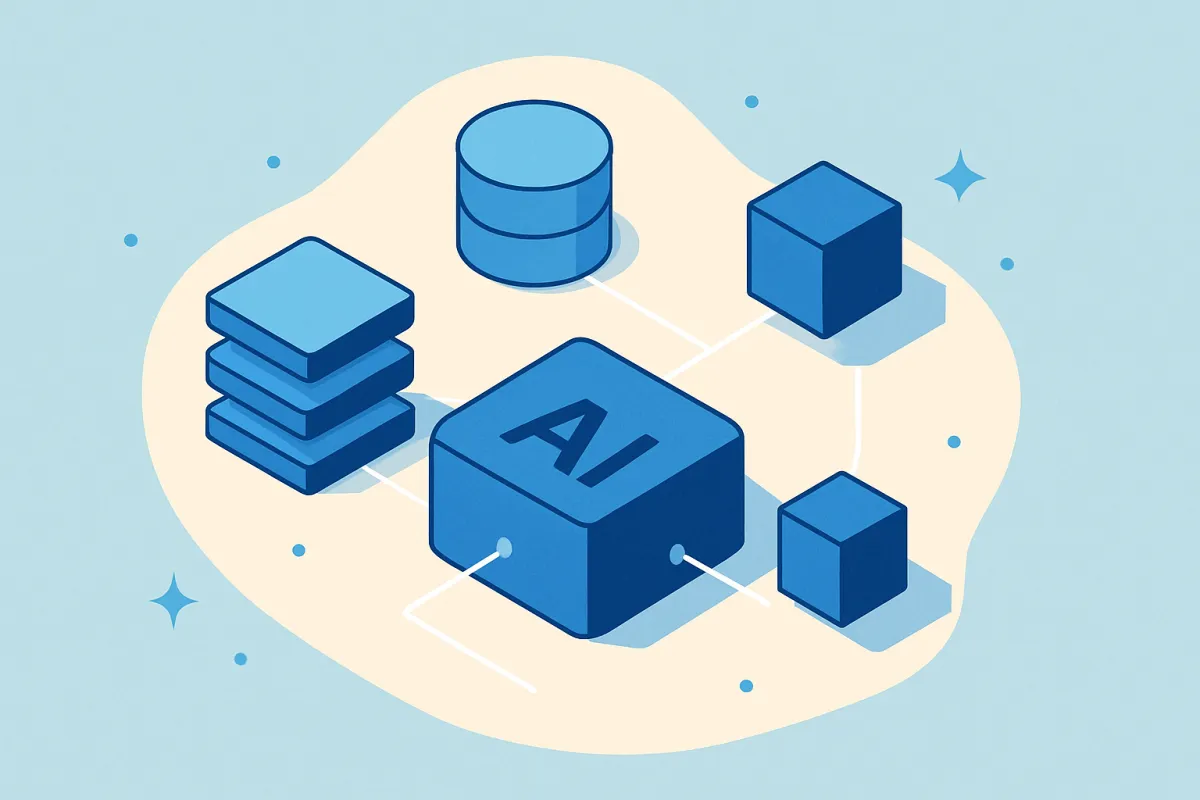
RAG (Retrieval-Augmented Generation) is an AI (Artificial Intelligence) architecture that combines information retrieval with text generation. Instead of relying solely on what an LLM (Large Language Model) learned during training, RAG first retrieves relevant documents from a knowledge source, then uses those documents as context for generating a response. The result is answers grounded in specific, verifiable sources rather than the model's general parametric memory.
An AI agent is an autonomous software system that perceives its environment, makes decisions, and takes actions to accomplish specific goals, in enterprise settings, this means completing complex workflows like RFP responses, questionnaire completion, and knowledge retrieval without human step-by-step direction.
Part of the AI Knowledge Base Hub
TL;DR
- RAG (Retrieval-Augmented Generation) is an AI (Artificial Intelligence) architecture that retrieves relevant documents from a knowledge source before generating a response, grounding every answer in specific verifiable sources rather than relying on what an LLM (Large Language Model) learned during training.
- RAG is the preferred architecture for enterprise knowledge work because it keeps knowledge current without retraining, provides source citations for every answer, and confines responses to your organization's own approved content.
- Fine-tuning permanently modifies a model's weights and is suited for teaching new skills; RAG leaves the model unchanged and provides current context at query time, making RAG better for grounding responses in live, proprietary enterprise data.
- The Brain uses RAG as its foundational architecture to generate cited, confidence-scored responses to RFPs (Requests for Proposal), security questionnaires, and sales questions from your organization's own documentation across 15 or more connected integrations.
- RAG systems assign a confidence score to each generated answer indicating how reliably the retrieved context supports the response; low-confidence answers route to SMEs (Subject Matter Experts) for review rather than submitting automatically.
RAG is the core architecture behind enterprise AI systems that need accuracy, traceability, and the ability to work with proprietary data. It is how the Brain generates cited responses to RFPs, security questionnaires, and sales questions from your organization's own documentation. And it is why AI-native platforms produce fundamentally more reliable outputs than tools that rely on general-purpose language models without a retrieval layer.
This guide explains how RAG works, why it matters for enterprise use cases, how it compares to other AI approaches, and how Tribble implements it to power knowledge-grounded proposal and sales workflows.
Key ConceptsKey Terms
- DDQ
- Due Diligence Questionnaire, a standardized set of questions used to evaluate a vendor's operational, financial, and compliance practices.
- RAG
- Retrieval-Augmented Generation, an AI architecture that combines a large language model with a search layer that retrieves relevant documents to ground each answer in verified source material.
- RFP
- Request for Proposal, a formal document issued by an organization inviting vendors to submit bids for a specific project or service.
- SOC 2 Type II
- SOC 2 Type II, a compliance framework developed by the AICPA that evaluates controls for security, availability, processing integrity, confidentiality, and privacy. Type II audits verify that controls were operating effectively over a defined period (typically 6–12 months).
How RAG works: the 5-step process
Every RAG system follows the same fundamental architecture, whether it is powering an RFP response tool a customer support bot, or a knowledge management platform. Here is the process using Tribble as the reference implementation.
-
Query intake
A question arrives. In Tribble, this could be an RFP question extracted from a procurement document, a security questionnaire item, or a question asked in Slack via Tribble Engage. The system interprets the intent and information need behind the question, understanding that "Describe your encryption practices" and "How do you protect data at rest and in transit?" are asking for the same information.
-
Knowledge retrieval
the Brain searches your connected knowledge sources (Google Drive, SharePoint, Confluence, Notion, Box, past RFP responses, CRM data) using semantic understanding rather than keyword matching. It finds the most relevant documents, passages, and data points across all connected systems simultaneously. This is the retrieval in retrieval-augmented generation, and it is what separates RAG from general-purpose AI chat.
-
Context assembly
Retrieved content is assembled into a context package. This is not a simple dump of documents: the system selects the most relevant passages, resolves conflicting information across sources, and prioritizes the most recent and authoritative content. The quality of context assembly directly determines the quality of the generated response.
-
Grounded generation
A large language model generates a response that is grounded in the assembled context rather than its general training data. The model synthesizes information from multiple retrieved sources into a coherent, contextually appropriate answer. In Tribble Respond this generates complete first-draft responses at 20 to 30 questions per minute.
-
Citation and confidence scoring
Every generated response is tagged with inline source citations identifying which documents contributed to the answer, plus a confidence score indicating how well-grounded the response is in the retrieved evidence. Low-confidence responses are automatically flagged for human review or routed to SMEs via Slack and Teams. This is the verification layer that makes RAG outputs trustworthy in enterprise contexts.
Key distinction: RAG does not replace human review. It replaces the manual research step: the hours spent finding, reading, and synthesizing information from scattered sources. Your team still reviews, edits, and approves. They just start from a cited first draft instead of a blank page.
For financial services teams: Asset managers, wealth advisors, and fund administrators face unique compliance requirements when responding to DDQs, investor questionnaires, and regulatory assessments. Tribble maps responses to your firm's compliance documentation automatically, with audit trails that satisfy SEC, FINRA, and fiduciary reporting standards.
Why RAG matters for enterprise AI
Three properties make RAG the preferred architecture for enterprise AI applications where accuracy is non-negotiable:
- Grounding reduces hallucinations. When a language model generates purely from its training data, it can produce plausible-sounding but incorrect information, hallucinations. RAG constrains generation to retrieved evidence, significantly reducing hallucination rates. For RFP response accuracy this is the difference between a useful first draft and a liability.
- Source citations enable verification. Every RAG-generated response can point to the specific documents it drew from. This is essential for compliance-heavy workflows like security questionnaires and DDQs where every answer must be auditable. Tribble includes inline citations and confidence scores per answer.
- Knowledge stays current without retraining. Fine-tuning a model to learn new information requires retraining: an expensive, time-consuming process that must be repeated every time information changes. RAG retrieves from live knowledge sources. When your security policy changes, or a new case study is published, RAG-based systems reflect the update immediately without any model changes.
Connect with a Tribble expert
See how teams answer RFPs, security questionnaires and deal questions from their own approved content, with every answer showing its source.
RAG vs. other AI approaches
Understanding how RAG compares to other approaches helps explain why it has become the default architecture for knowledge-intensive enterprise applications.
| Approach | How it works | Best for | Key limitation |
|---|---|---|---|
| RAG (Tribble's architecture) | Retrieves relevant documents from connected knowledge sources, then generates grounded responses with citations and confidence scores. | Enterprise knowledge work: RFPs, security questionnaires, sales enablement, compliance. Any task where accuracy, traceability, and current knowledge matter. | Quality depends on retrieval quality. If knowledge is not documented or connected, the system cannot retrieve it. |
| Fine-tuning | Modifies a language model's weights by training on additional data. Changes the model permanently. | Teaching a model new skills, styles, or domain-specific language patterns. | Expensive to retrain. Cannot trace outputs to sources. Knowledge is frozen at training time. |
| Prompt engineering | Crafts specific prompts to guide a general-purpose model's responses. No retrieval or model modification. | Simple, ad-hoc tasks where general knowledge is sufficient and traceability is not required. | No access to proprietary data. Cannot cite sources. Highly dependent on prompt quality. |
| Library-based search | Keyword or semantic search against a manually curated content library. Returns matching entries without generation. | Teams with well-maintained content libraries where copy-paste from existing answers is sufficient. | No synthesis across sources. Novel questions return no match. Library accuracy degrades without maintenance. |
For teams evaluating content library vs. knowledge graph architectures RAG represents the knowledge graph approach: live retrieval across your full corpus rather than search against a static library.
IDC projects that worldwide spending on AI in enterprise applications will reach $154B by 2027, with sales and compliance automation growing fastest.
See RAG in action on your own knowledge
Used by leading enterprise B2B teams across fintech, healthcare IT, and cybersecurity.
How Tribble implements RAG
Tribble's entire product suite is built on RAG architecture. Understanding how each product uses retrieval-augmented generation clarifies why the approach produces better outcomes than general-purpose AI tools or library-based search.
- The Brain is the retrieval and knowledge layer. It connects to your organization's knowledge sources, Google Drive, SharePoint, Confluence, Notion, Box, Salesforce, past RFP responses, and maintains a continuously updated index. When any Tribble product needs to answer a question, The Brain performs the retrieval step: finding the most relevant content across all connected systems using semantic understanding. Tribble integrates with 15+ enterprise tools.
- Tribble Respond applies RAG to structured document workflows. When an RFP or security questionnaire is ingested, Respond extracts every question, sends each to the Brain for retrieval, and generates cited first drafts at 20 to 30 questions per minute. Each answer includes confidence scores and source citations so reviewers can verify accuracy before submission.
- Tribble Engage applies RAG to real-time conversational workflows. When someone asks a question in Slack or Teams, about product capabilities, pricing, security posture, or competitive positioning, Engage retrieves the relevant knowledge from the Brain and generates a cited answer in the channel. This is RAG applied to sales enablement knowledge delivery.
- Tribblytics closes the feedback loop by tracking which RAG-generated content correlates with positive outcomes. It monitors confidence score distributions, content reuse patterns, and content-outcome correlations, feeding insights back into the system to improve retrieval quality over time.
The system is SOC 2 Type II certified with AES-256 encryption, TLS 1.2+, SSO, and RBAC. Your data is never used to train shared models. Tribble has generated over 1M+ AI-powered responses for enterprise teams. Tribble is rated a G2 Momentum Leader in RFP Software (Fall 2026).
Enterprise RAG use cases
RAG powers knowledge-intensive workflows wherever accuracy, traceability, and proprietary data matter. The highest-value enterprise use cases share three characteristics: questions require organization-specific knowledge, answers must be verifiable, and the underlying knowledge changes regularly.
- RFP and proposal response automation. Every RFP question requires organization-specific answers drawn from scattered knowledge sources. RAG retrieves the right content and generates cited first drafts. This is Tribble Respond's primary use case. See the full RFP software comparison for how RAG-based tools compare to alternatives.
- Security questionnaire automation. Vendor security assessments require precise, auditable answers about your organization's security controls, certifications, and data practices. RAG ensures every answer is grounded in your actual security documentation with source citations that satisfy audit requirements. See the complete guide to security questionnaire automation.
- Sales enablement knowledge delivery. Sales teams need instant access to product knowledge, competitive intelligence, and deal-specific context. RAG-powered tools like Tribble Engage deliver cited answers in Slack and Teams rather than requiring reps to search through documentation portals. See the sales enablement tools comparison.
- Compliance and regulatory response. Compliance teams face recurring questions about policies, controls, and certifications across audits, customer inquiries, and regulatory filings. RAG ensures responses are grounded in current policy documents rather than outdated or incorrect information.
- Internal knowledge management. Organizations lose significant productivity when employees cannot find the information they need. RAG-powered AI knowledge bases answer questions from the full corpus of connected documentation rather than requiring users to know where to search.
RAG limitations and how to address them
RAG is not a silver bullet. Understanding its limitations helps teams set accurate expectations and architect their systems for maximum reliability.
McKinsey's 2025 State of AI report found that organizations adopting AI across go-to-market functions see 20–30% improvements in efficiency metrics.
- Retrieval quality is the ceiling. A RAG system cannot generate from knowledge it did not retrieve. If the answer exists in a document that is not connected to the system, or if the retrieval model fails to find the right passage, the generated response will be incomplete. Tribble addresses this by connecting to 15+ knowledge sources and using continuous improvement on retrieval quality.
- Knowledge must be documented. RAG retrieves from written documentation. Institutional knowledge that exists only in people's heads is invisible to the system. This is why connecting comprehensive knowledge sources during deployment is the single most important implementation step. Tribble's knowledge base building process addresses this systematically.
- Semantic mismatch can cause retrieval failures. When questions use different terminology than source documents, retrieval accuracy drops. Advanced RAG implementations use semantic understanding rather than keyword matching to bridge these gaps, but edge cases remain.
- Confidence scoring is essential, not optional. Without confidence scoring, your team has no way to distinguish well-grounded responses from ones where retrieval was weak. Tribble includes confidence scores on every response specifically because RAG quality varies by question.
How Tribble differs from compliance-only tools like Vanta
Vanta automates compliance monitoring and evidence collection. Tribble automates the response itself, generating first drafts from your approved knowledge base with source attribution so compliance teams can verify claims against approved documentation.
Vanta automates compliance monitoring and evidence collection. Tribble automates the response itself. If your team spends hours filling out questionnaires that reference compliance data, Tribble pulls from your approved knowledge base, generates first drafts with source attribution, and routes them for review. The two solve different problems: Vanta proves you are compliant, Tribble helps you communicate that compliance faster in RFPs, DDQs, and security assessments.
RAG in enterprise AI by the numbers
per-answer accuracy rates reported by RAG-based enterprise platforms with well-connected knowledge sources.
reduction in response time when RAG automates the research and first-draft generation steps of knowledge-intensive workflows.
Forrester Research estimates that AI-powered B2B tools deliver an average ROI of 340% within the first 18 months of deployment.
AI-powered responses processed on the Tribble platform, with RAG architecture powering every response.
enterprise integrations supported by the Brain, providing the connected knowledge sources that power RAG retrieval.
RAG implementation readiness checklist
- Audit your organization's knowledge sources before selecting a RAG (Retrieval-Augmented Generation) platform: identify all systems where authoritative content lives (Confluence, SharePoint, Google Drive, Slack, CRM, past RFP documents) and assess how frequently each source updates.
- Confirm the platform uses live connectors to source systems rather than one-time uploads so the retrieval index stays current when underlying documents change.
- Verify that the chunking and embedding strategy is tuned for your content type: long compliance documents require different chunking than short Slack messages or structured Q&A pairs.
- Ensure confidence scoring is enabled so low-confidence answers route to the appropriate SME (Subject Matter Expert) for review rather than being submitted automatically.
- Test retrieval quality on your actual content before committing: generate answers for 20 known RFP (Request for Proposal) or security questionnaire questions and compare Tribble's cited sources against your expected authoritative sources.
- Build a feedback loop: route reviewer edits and corrections back into the retrieval system so the most accurate, approved content rises in retrieval ranking over time.
How Tribble Compares
Responsive: Unlike Responsive's library-first approach, Tribble uses AI-first RAG to generate accurate first drafts from your existing knowledge without requiring manual answer curation.
Loopio: Where Loopio relies on manual content maintenance, Tribble's auto-learning knowledge base stays current by ingesting new responses, documents, and call intelligence automatically.
Vanta: Vanta monitors compliance posture; Tribble automates the response side, answering the security questionnaires, DDQs, and assessments that compliance monitoring generates.
What are the best tools for responding to RFPs faster?
The best RFP response tools in 2026 fall into three categories: AI-native drafting platforms, content library managers, and process automation tools. AI-native platforms like Tribble generate complete first drafts using retrieval-augmented generation, pulling context from your approved knowledge base and citing sources on every answer. Content library managers like Responsive and Loopio help teams search and reuse past answers. Process tools like Jaggaer manage workflow and approvals.
The biggest time savings come from the drafting step. Teams using AI-native tools report 70-80% reduction in per-response time because the AI handles the first draft, not just the search. For organizations handling 50+ RFPs annually, the difference between searching a library and generating a draft is the difference between incremental improvement and a step change in throughput.
Key Takeaway
Learn what retrieval-augmented generation (RAG) is, how it works, and why it powers the most accurate enterprise AI systems. Understand the architecture behind AI tools like Tribble that generate grounded, cited responses from your organization's own data.
Feature Comparison: Tribble vs Responsive vs Loopio vs Vanta
Frequently asked questions
RAG (Retrieval-Augmented Generation) is an AI (Artificial Intelligence) architecture that combines information retrieval with text generation. Instead of relying solely on what a language model learned during training, RAG first retrieves relevant documents from a knowledge source, then uses those documents as context for generating a response. This produces answers grounded in specific, verifiable sources. The Brain uses RAG as its foundational architecture to generate cited, confidence-scored responses from your connected knowledge.
Fine-tuning modifies a language model's weights by training it on additional data, permanently changing how the model generates responses. RAG leaves the model unchanged and provides relevant context at query time. Fine-tuning is better for teaching new skills or styles. RAG is better for grounding responses in specific, current, verifiable information, which is why it is the preferred architecture for enterprise knowledge work like RFP automation and security questionnaire response.
RAG reduces hallucinations by constraining the language model to generate from retrieved evidence rather than its parametric memory. When generating from retrieved documents, the output is grounded in specific sources that can be verified. RAG does not eliminate hallucinations entirely, but it significantly reduces them and makes errors detectable through source citations. Tribble adds confidence scoring to further flag responses where retrieval quality was weak.
Tribble uses RAG as its core architecture. The Brain connects to your knowledge sources (Google Drive, SharePoint, Confluence, Notion, Box, CRM) and retrieves relevant content for every question. Tribble Respond generates cited first drafts for RFPs and questionnaires at 20 to 30 questions per minute. Tribble Engage delivers cited answers in Slack and Teams. Every response includes source citations and confidence scores.
A knowledge base is where information is stored. RAG is how that information is retrieved and used to generate responses. A traditional knowledge base requires users to search and find information manually. A RAG-powered AI knowledge base like the Brain retrieves information automatically based on the question and generates contextual answers with citations. The knowledge base is the data layer; RAG is the intelligence layer.
Yes. Enterprise RAG systems are designed for internal data. Tribble connects to 15+ knowledge sources including Google Drive, SharePoint, Confluence, Notion, Box, and CRM systems. Your data stays in your environment and is never used to train shared models. SOC 2 Type II compliance, AES-256 encryption, TLS 1.2+, SSO, and RBAC ensure your data remains secure.
RAG quality depends on retrieval quality. Common limitations include retrieval gaps when knowledge is not documented, semantic mismatch when questions use different terminology than source documents, and context window constraints. Tribble addresses these through broad knowledge source connectivity (15+ integrations), semantic understanding across terminology variations, and confidence scoring that flags low-quality retrievals for human review.
What is the best RFP automation software?
The best RFP automation software depends on your workflow. For AI-first drafting with source attribution, Tribble generates complete first drafts from your knowledge base. For content library management, Responsive and Loopio organize past answers for manual reuse. Teams handling 50+ RFPs per year see the largest ROI from AI-native tools that automate the drafting step, not just the organization step.

See RAG-powered AI
on your own knowledge
Grounded answers. Source citations. Confidence scores. From your connected documentation.
★★★★★ Rated 4.7/5 on G2 (Source: G2.com, Inc.) · G2 Momentum Leader, RFP Software, Fall 2026 · Used by leading B2B teams.